
Table of Contents
- What Differentiated Instruction Means and Why AI Changes It
- How AI Enables Adaptive Learning and Real-Time Feedback
- Creating AI Prompts for Differentiated Instruction
- Generating AI-Created Reading Passages for Different Levels
- Best Practices for AI in the Classroom
- Maintaining Academic Integrity and Student Safety
- Measuring Efficacy of Your AI-Differentiated Lessons
- Conclusion
*Last Updated: September 27, 2026*
What Differentiated Instruction Means and Why AI Changes It
Differentiated instruction is the practice of tailoring teaching methods, content, and assessments to meet individual student needs. Rather than delivering the same lesson to all students, teachers adjust their approach based on each learner's readiness, interests, and learning style.
Classrooms are never homogeneous. Without differentiation, struggling students fall further behind while advanced learners get bored.
AI transforms differentiation from an ideal into something teachers can implement at scale, making using ai to differentiate instruction for students practical and efficient. Instead of manually creating five lesson versions, teachers can generate tailored content in minutes using structured prompts.
How AI Enables Adaptive Learning and Real-Time Feedback
Adaptive learning systems adjust difficulty and content based on student performance, serving simpler explanations when students struggle and advancing to harder material when they succeed.
AI makes this possible by:
- Generating multiple versions of the same concept at different complexity levels
- Creating targeted feedback that explains why an answer is wrong and how to correct it
- Adjusting pacing based on student responses without teacher intervention
- Providing real-time data so teachers see which students need help immediately
Teachers see patterns within days instead of weeks and can adjust instruction immediately. Students don't get stuck on concepts because feedback happens fast enough to matter.
One critical caveat: AI-generated feedback must be reviewed by a human. A language model can produce plausible-sounding explanations that contain subtle errors. Teachers should use AI as a starting point, then refine the feedback before students see it.
Creating AI Prompts for Differentiated Instruction
AI-generated content quality depends entirely on prompt structure. Specific prompts yield usable materials; vague requests produce generic results.
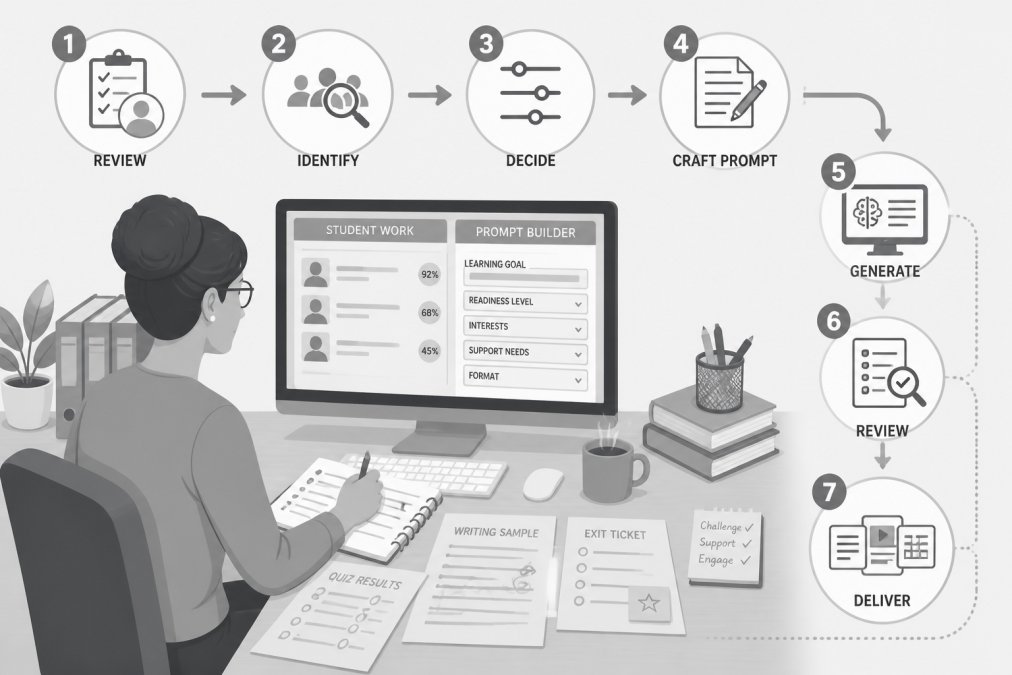
A strong prompt includes:
- The learning objective (what students should understand or do)
- The student level (struggling reader, on-grade, advanced)
- The format you want (multiple choice, short answer, matching)
- Any constraints (reading level, vocabulary to avoid, cultural relevance)
Here's an example prompt structure:
Create a reading comprehension question about photosynthesis for a 4th-grade student reading at a 2nd-grade level. Use simple sentences with one-syllable words where possible. Include a multiple-choice answer with four options. Make one option a common misconception.
This prompt is specific enough that the AI output will be usable. A vague prompt like "Create a question about photosynthesis" produces generic results that don't fit your students' actual needs.
Crafting effective prompts takes practice. After 10-15 prompts, most educators develop a feel for what works, and reuse pays off across years and classes.
Generating AI-Created Reading Passages for Different Levels
AI can generate original passages tailored to specific reading levels, topics, and vocabulary, saving time on sourcing and modification.
Request passages by specifying:
- Reading level (use grade level or Lexile score if you know it)
- Topic (aligned to your curriculum)
- Length (number of sentences or paragraphs)
- Key vocabulary to include or avoid
- Comprehension focus (main idea, inference, vocabulary)
An effective prompt might read:
Write a 150-word passage about the water cycle for a 3rd-grade student reading at a 2nd-grade level. Use short sentences. Include the words: evaporation, condensation, precipitation. Make the passage interesting by adding a real-world example about rain in a garden.
The AI generates a passage you can use immediately or refine for accuracy and classroom context.
One important note: always check generated passages for factual accuracy. Language models occasionally produce plausible-sounding but incorrect information. A quick review catches these errors before students encounter them.
Best Practices for AI in the Classroom
Start with your learning objective, not the tool. Decide what students need to learn first. Then ask whether AI is the right tool to help. Sometimes it is. Sometimes a traditional worksheet or discussion works better.
Review all AI-generated content before students see it. This is non-negotiable. Check for accuracy, appropriateness, and alignment with your standards. A five-minute review prevents problems.
Use AI to save time on routine tasks, not to replace your expertise. AI excels at generating multiple content versions and draft feedback but does not replace your judgment about student needs.
Maintain academic integrity. Make clear that using AI to do their work is plagiarism, while using it as a learning tool is acceptable. Control what tools students can access to prevent confusion about expectations.
Track which differentiation strategies work for which students. Over time, patterns emerge about who benefits from visual scaffolding versus repetition. Use this to refine prompts and content.
Maintaining Academic Integrity and Student Safety
AI in education raises legitimate concerns about plagiarism, data privacy, and student safety. These deserve serious attention, and concrete, actionable protocols, not just warnings.
Plagiarism and AI-generated work. Make expectations clear: students should not submit AI-generated work as their own, but can use AI to brainstorm, get feedback, or understand concepts. The line is whether the student did the thinking. Document your policy in your syllabus and review it at the start of the year. AI-detection tools are imperfect and should never be your sole evidence of cheating.
Data privacy and compliance. This is where many teachers stumble. When you input student work, names, or performance data into an AI tool, you're transmitting that information to a third party.
Before adopting any AI tool, verify:
- Data Processing Agreement (DPA): Legal contract stating how student data is used, stored, and protected. Do not use tools without one.
- Encryption: Data should be encrypted in transit and at rest.
- Model training: Vendor should not use student data to train AI models. Free tiers often do; paid education tiers typically don't.
- Data retention: Get the vendor's policy in writing. Can you request deletion?
- FERPA compliance: Required if your school receives federal funding (most do).
- COPPA compliance: Required for students under 13; requires parental consent.
Measuring Efficacy of Your AI-Differentiated Lessons
Track the impact of AI-differentiated instruction with structured metrics, not vague questions like "Did performance improve?"
Use a simple spreadsheet to track:
| Unit | Instruction Type | Pre-Assessment Avg | Post-Assessment Avg | Growth % | Completion Rate | Student Feedback |
|---|---|---|---|---|---|---|
| Unit 1 (Fractions) | Traditional | 62% | 77% | +15% | 92% | "Okay, but confusing" |
| Unit 2 (Decimals) | AI-Differentiated | 58% | 80% | +22% | 96% | "Materials matched my level" |
| Unit 3 (Percentages) | AI-Differentiated | 61% | 83% | +22% | 97% | "Good scaffolding" |
- Declining engagement: Students complain that materials are boring or irrelevant, even though they're supposedly differentiated. This usually means your prompts aren't specific enough, or the AI is generating generic content.
- Widening achievement gaps: If advanced students improve but struggling students don't, the differentiation isn't reaching the students who need it most.
- Teacher burnout: If reviewing and refining AI-generated content takes more time than creating materials from scratch, the tool isn't saving you time. Reconsider your workflow.
- Inconsistent quality: Some AI-generated lessons are great; others are mediocre. This suggests your prompts need refinement or you need a different tool.
Conclusion
---
Using AI to differentiate instruction for students is no longer theoretical. The tools exist. The challenge is implementation: creating effective prompts, reviewing generated content, maintaining academic integrity, and measuring what actually works in your classroom.
Frequently Asked Questions
How do I use AI to differentiate instruction without losing academic integrity?
Use AI to create scaffolded assignments, reading passages at different levels, and personalized feedback, but require students to complete work within a controlled environment where you can monitor their process. Set clear expectations: AI can help them learn, but their final submission must reflect their own thinking. Use a structured platform that logs student activity and allows you to review how they arrived at their answers, not just the final output.
What are the best AI prompts for differentiated instruction across reading levels?
Craft prompts that specify the reading level, learning outcome, and scaffolding needed. For example: 'Create a 200-word summary of [topic] using grade 3 vocabulary and simple sentence structures' or 'Generate discussion questions at a high school level that require inference and critical thinking.' Include the specific skill you're targeting, comprehension, vocabulary, analysis, so the AI output matches your instructional goal and the student's actual level.
Can AI help me differentiate instruction for students with IEPs or ADHD?
Yes. AI can generate shorter passages, provide sentence starters, create graphic organizers, and deliver real-time feedback, all common accommodations. You control what the AI produces: request simplified text, chunked instructions, or multi-modal content (text plus visuals). However, verify that the AI output actually meets the specific accommodation listed in each student's IEP or 504 plan, and always pair AI tools with human review to ensure accessibility standards are met.
How do I measure whether AI-differentiated lessons actually improve student learning?
Track formative assessment data before and after implementing AI-differentiated instruction: pre-test scores, assignment completion rates, quality of student work, and progress toward learning outcomes. Compare performance across student groups (by reading level, learning disability, or engagement level) to see if the gap is narrowing. Collect teacher feedback on time spent on lesson prep and grading. Look for consistent improvement over 4-6 weeks, not just one assignment.