
Why Spotting AI-Generated Essays Is Harder Than You Think
A student who never turns in a draft suddenly submits a polished essay with flawless grammar and no personal anecdotes. You suspect AI wrote it, but proving it is another matter entirely. Detecting AI-written student work is a pressing challenge, yet the tools designed to help teachers often create more problems than they solve.
Generative models have become remarkably sophisticated at mimicking human writing patterns. The line between AI-assisted and AI-generated writing is blurring faster than detection methods can adapt.
Most guides frame this as a simple cat-and-mouse game. That framing is wrong. Detection software reports a predictive probability, not a certainty, and a false accusation can permanently damage student trust. The goal is to protect academic integrity while treating students fairly.
Below, we'll cover the practical signs of AI writing, how to use detection tools correctly, a verification process that holds up to scrutiny, and assignment design strategies that make AI cheating harder.
Signs of AI Writing in Student Essays: What to Look For
AI-generated writing detection relies less on a single smoking gun and more on recognizing a cluster of stylistic shifts across a student's work. The most reliable approach is comparative: you need to know what the student's authentic writing looks like before judging whether a submission deviates from it.
The deeper question isn't just "Did a machine write this?" It's "What level of AI involvement are we dealing with?" Most guides treat AI use as binary, but the reality is a spectrum.
Differentiating AI-Assisted from AI-Generated Work
A student who uses Grammarly to fix commas is not committing the same offense as one who prompts ChatGPT to write the entire essay. Yet many school policies, and teachers' instincts, treat them identically, leading to inconsistent enforcement and defensible student pushback.
A practical framework separates three levels of involvement:
- AI-assisted (acceptable with citation): The student generates ideas, outlines, and drafts the core argument. They use AI for brainstorming, grammar correction, or paraphrasing a single difficult sentence. The intellectual work is theirs.
- AI-collaborative (gray area): The student provides the thesis and key evidence, but asks the AI to write full paragraphs or structure the argument. The student edits the output. This is where most policy disputes arise.
- AI-generated (unacceptable): The student inputs the prompt and submits the output with minimal or no editing. The intellectual work is outsourced entirely.
When you spot a stylistic anomaly, your first step isn't accusation, it's determining which category you're looking at.
Patterns in Word Choice and Sentence Structure
Generative models default to a predictable register: balanced sentence lengths, no fragments, few stylistic risks. Human writers, especially students, are inconsistent, run-ons when rushed, fragments for emphasis, and occasional misuse of words they've only heard spoken.
Look for these specific patterns:
- Uniform paragraph lengths with no variation in rhythm
- Transition words used with mechanical precision ("Furthermore," "Moreover," "In conclusion" at the start of every paragraph)
- Vocabulary that sits noticeably above the student's demonstrated range
- Absence of regional dialect, idioms, or personal catchphrases
- Grammatical perfection that never slips, even in casual asides
A student writing about their summer job will mention a specific coworker, a frustrating customer, or a moment of panic. AI text describes the experience in the abstract because it cannot recall sensory details that never happened.
The "Surface Competence" Problem and the Voice Audit
AI essays often demonstrate "surface competence": correct structure, clear thesis, relevant evidence. But the writing lacks the messy particularity of lived experience. Claims remain generic, examples could apply to anyone, and the voice sounds like a textbook rather than a teenager.
To move beyond gut feeling, run a quick voice audit: take three paragraphs and ask whether they could have been written by any student in the class or reflect this specific student's perspective, vocabulary, and concerns. If the answer is "any student," you have a red flag.
The strongest indicator of AI involvement is a sudden, unexplained shift in writing style. When draft submissions show fragmented thinking and conversational language, but the final essay reads like a peer-reviewed journal article, something changed. That change demands a conversation, not an accusation.
Treating a single polished essay as proof of AI use without comparing it to the student's earlier work is the fastest route to a false accusation. Always gather baseline writing samples before making any judgment.
A Note on Non-Native Speakers and Neurodivergent Students
The signs above are not equally reliable for every student population. Non-native English speakers often write in clear, grammatically correct, formulaic patterns because that is how they were taught. Neurodivergent students may write in unusually uniform or structured ways. For these students, the patterns that flag AI involvement in a native speaker's essay are simply their authentic baseline.
This is why the comparative method matters more than any checklist. You are looking for deviations from a specific student's documented writing history. If you lack that history, you lack the foundation for any judgment.
AI Detection Tools for Teachers: How to Use Them Correctly
AI detection tools are probabilistic classifiers, not truth machines. They analyze text patterns and assign a likelihood that content was machine-generated. Understanding this distinction changes how you interpret their output.
Most tools examine perplexity (how predictable the text is) and burstiness (sentence length variation). These heuristics work reasonably well on unmodified AI output, but they fail when text has been lightly edited or paraphrased.
Understanding False Positives and Algorithmic Bias
The uncomfortable truth is that detection software produces false positives at concerning rates. Research from the Journal of Academic Ethics on AI detection reliability has documented cases where human-written text, particularly from non-native English speakers and neurodivergent students, was flagged as AI-generated. The algorithmic bias embedded in these tools punishes clear, formulaic writing that follows standard essay structures.
A well-structured essay by a diligent student who reads the rubric carefully can look more "AI-like" than an actual AI essay that has been deliberately roughened up. Students who write in straightforward, grammatically correct sentences face a higher risk of being flagged.
Detection tools must be used as a conversation starter, never as a verdict. A positive result should trigger a private discussion, not an automatic zero.
Detection software provides a lead for investigation, not evidence of misconduct. Treat every positive result as a prompt to gather more information before you act.
Step-by-Step: How to Verify Suspected AI Use
When you suspect AI involvement, follow a structured verification process that protects both academic integrity and student rights, moving from evidence gathering to conversation without a premature accusation.
- Collect baseline writing samples. Pull together earlier assignments, in-class writing, and draft submissions from the same student. Compare vocabulary complexity, sentence structure, and stylistic patterns against the flagged submission.
- Run multiple detection passes. Use at least two different detection tools and compare their scores. Discrepancies between tools suggest the text may be edited AI output or human writing with unusual patterns. Document all results.
- Examine metadata and revision history. If your platform tracks version history, check whether the document was written in chunks over time or appeared suddenly. Rapid creation of a complete essay warrants closer inspection.
- Ask the student to explain their process. Request that they walk you through their research, outline, and drafting decisions. Ask about specific word choices and structural choices in the essay. Students who wrote the piece can answer these questions naturally.
- Conduct an oral defense for borderline cases. Have the student summarize their argument and key evidence without referring to their notes. This conversation typically resolves ambiguity faster than any software analysis.
- Document everything. Record your findings, the detection scores, and the outcome of your conversation. This paper trail protects you if the decision is challenged by parents or administrators.
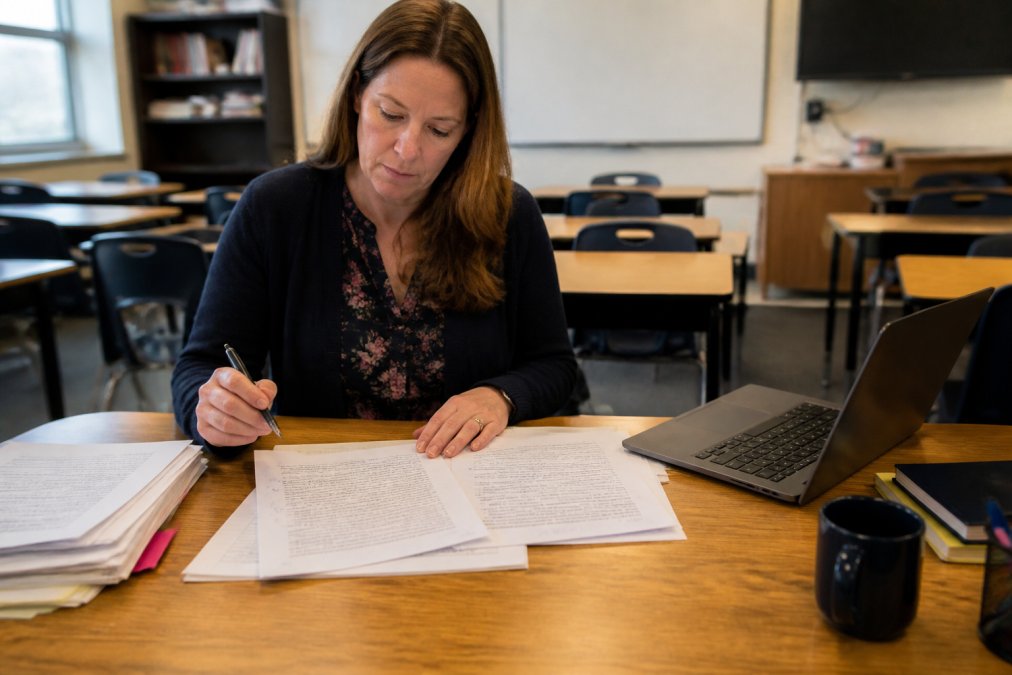
The verification process is not about building a case against a student; it is about establishing facts before you act. When schools follow this process consistently, students understand that policies are enforced fairly, not arbitrarily.
For borderline cases, ask the student to rewrite a single paragraph from memory during a supervised session. Compare the vocabulary and sentence structure to the flagged submission. The difference is usually revealing.
How to Prevent AI Cheating in the Classroom With Better Assignments
The most effective way to detect AI-written student work is to design assignments that make AI use impractical. Detection is reactive; assignment design is proactive. Shifting assessment toward process and personalization reduces the incentive to cheat.
Process-based assessment values the journey over the destination. Students submit outlines, annotated bibliographies, and drafts at checkpoints, creating a documented trail of their thinking. A student who has submitted three authentic drafts cannot suddenly produce an AI-generated final essay without the inconsistency becoming obvious.
The International Center for [Academic Integrity(https://www.classroomwriter.com/blog/ai-academic-integrity-scale-guide) guidance on assessment design | academicintegrity.org] recommends that institutions move away from high-stakes, single-submission essays toward iterative assignments that reward genuine engagement with the material.
The Specificity Principle: Why Generic Prompts Fail
Generic prompts are an open invitation to AI use. "Discuss the causes of World War I" or "Analyze the theme of isolation in Frankenstein" have been answered millions of times. Language models will produce a competent, well-structured response every time.
The fix is the Specificity Principle: a prompt is AI-resistant to the degree that it references information a language model cannot possess, your specific class sessions, your specific students' experiences, and your specific local context.
Prompt Engineering for Teachers: Three Structural Moves
Move 1: Anchor to Unshareable Classroom Events.
Reference something that happened in your room that no AI could know. A single clause can transform a generic prompt into an AI-resistant one.
- Weak: "Analyze the author's use of symbolism in Chapter 4."
- Strong: "In Tuesday's discussion, Maria challenged the class's reading of the green light as purely symbolic. Using her counterargument as a starting point, evaluate whether the symbol's meaning shifts when read through a Marxist lens."
The second prompt requires the student to have been in the room, heard Maria's specific argument, and engaged with a peer's live contribution. An AI model has none of that context.
Move 2: Require Synthesis of Conflicting Sources You Provide.
Instead of asking students to summarize a topic, give them two short sources that directly contradict each other and require them to adjudicate the conflict. This forces original reasoning rather than regurgitation.
- Weak: "Summarize the main arguments for and against school uniforms."
- Strong: "Source A argues uniforms reduce socioeconomic bullying. Source B presents data showing bullying rates unchanged after uniform adoption. Both use credible methodology. Which source's evidence is more persuasive, and what specific flaw in the other source's reasoning undermines its conclusion?"
Move 3: Force Personal, Verifiable Connection.
Require students to connect course concepts to their own observations, experiences, or local context. The more specific the personal anchor, the harder it is for AI to fabricate.
- Weak: "Discuss the challenges of teamwork."
- Strong: "Describe a specific moment in our group project when a team member's suggestion changed your approach. What was the suggestion, why did you initially resist it, and what did the final outcome teach you about collaboration?"
A prompt that asks "What did you find most challenging about the group project and how did you resolve it?" resists AI generation because it demands specific, personal details no language model possesses.
The In-Class Writing Anchor
Even the best prompt design can be circumvented. The most reliable prevention method is to anchor summative assessment in supervised, in-class writing, reserving the highest-stakes writing for the classroom.
A practical structure is the two-stage essay:
- Stage 1 (Take-home): Students research, outline, and draft their argument at home. This stage allows for AI assistance with brainstorming and structure, which you can explicitly permit and require them to disclose.
- Stage 2 (In-class): Students write a timed, handwritten or lockdown-browser essay responding to a narrower prompt derived from their own thesis. They have their outline and sources, but the actual prose is produced under supervision.
This structure preserves the benefits of take-home research while ensuring the final product is authentically the student's, eliminating the most common cheating scenario: a polished final essay with no drafting trail.
A Note on AI-Assisted Writing Policies
Prevention isn't just about making cheating harder, it's about defining what cheating means. If your syllabus doesn't distinguish between acceptable AI assistance (grammar checking, brainstorming) and unacceptable AI generation (full paragraph drafting, thesis creation), you're enforcing an unwritten rule.
Adopt a simple disclosure policy: students must note any AI tool they used and how. This normalizes transparency and moves the conversation from "gotcha" to "process." When students can disclose AI assistance without automatic failure, they're far less likely to hide full generation.
Test your own prompts before assigning them. Run your strongest prompt through a free AI tool and see what it produces. If the output is a competent essay, the prompt needs more specificity. If the output is generic or hallucinated, you've built a solid barrier.
Formative assessment through drafts and peer review also builds digital literacy. When students practice giving and receiving feedback on authentic writing, they develop a stronger sense of their own voice, their defense against the temptation to outsource their thinking.
Protecting Students From False Accusations
False accusations of AI cheating carry real consequences: damaged student-teacher relationships, disciplinary records, and psychological harm. Schools that rely heavily on detection software without clear policies risk punishing innocent students based on unreliable algorithmic output.
The legal and policy framework for these situations is still developing. guidance on academic integrity policies from the US Department of Education emphasizes that institutions must ensure their disciplinary processes provide due process and evidence-based decision-making. A detection score alone does not meet that standard.
Schools should establish clear academic honesty policies that define AI misuse, distinguish between AI-assisted and AI-generated work, and outline the verification process before disciplinary action. These policies should be communicated to students and parents at the start of the school year.
Students also need a pathway to challenge accusations. When a student disputes a finding, schools should have a review process that includes multiple perspectives, protecting students from a single teacher's misreading and teachers from accusations of bias.
Never confront a student with "the AI detector says you cheated" as your opening statement. Detection scores are probabilistic, not factual. Begin with curiosity about their writing process, not an accusation.
Conclusion: A Balanced Approach to Academic Integrity
Artificial intelligence is not going anywhere, and neither is the temptation to use it dishonestly. Schools that thrive will treat AI as a reality to be managed rather than a threat to be eliminated through surveillance.
The balanced approach combines thoughtful assignment design, transparent policies, and human judgment. Detection tools have a role, but the most reliable signal remains your knowledge of your students and their authentic writing voices.
Classroom Writer supports teacher-led assessment creation and import with compatible AI platforms, including ChatGPT, Claude, Gemini, Mistral, Microsoft Copilot Studio and Perplexity. The teacher reviews and approves the proposed materials before delivery. These connections do not mean that a student-facing chatbot is embedded in every assessment, that AI-provider subscriptions are included, or that CW records conversations in external AI services.
Start free with Classroom Writer and build an assessment workflow that prioritizes student learning over detection anxiety.
Using Classroom Writer for this workflow
Explain the limits of each signal. A task event or rapid-input flag can identify something to review, but cannot determine that a text was written by AI or supply a plagiarism match.
CW supports teacher-designed, cross-subject assessments: short and extended answers, multiple-choice questions, editable tables, graphs, diagrams, drawing, annotation and image labelling. Teachers choose permitted resources, editable areas, timing and clipboard conditions.
Subject tools include the GeoGebra Calculator Suite, Transformation Grid, Maths & Science Canvas, equations and calculators, Music Studio, bounded simulations and selectable simulation libraries. Prepare the tools needed for the task; some specialist tools require teacher setup after an AI-assisted import. Teachers request GeoGebra access, which eligible requests receive automatically; student use is free.
The reusable rubric library supports preparation and teacher review. Portfolio Hub supports longer projects and evidence over time; live Google draft review and related checkpoint features are restricted pilot capabilities, not universal entitlements. The multilingual interface and Training Mode support practice; changing the interface language does not translate authored assessments.
Classroom Writer lets teachers set permitted resources and tools, control editable areas and clipboard permissions, and review relevant activity recorded in the assessment workspace. CW is not a plagiarism-matching engine or a definitive AI-authorship detector. Rapid-input and other integrity signals prompt teacher review; they are not proof of AI use or misconduct. These records do not establish what happened in another app, browser tab or device, and do not provide a complete external AI conversation or keystroke history.
Classroom Writer's published offer is a 30-day free trial, rather than a permanent free plan. The current individual teacher prices are $4.99/month or $49/year; school plans start at $39.90/month or $390/year for 10 teacher seats. Check the current plans before purchasing. Third-party AI subscriptions are separate.
Frequently Asked Questions
How do teachers tell if something is written by AI?
Teachers combine several signals rather than relying on one tool. Look for a sudden shift in writing style compared to past work, generic phrasing, and perfectly uniform grammar. The most reliable method is checking inconsistencies between a student's in-class writing and their submitted essay. Talking to the student about their drafting process often reveals more than any software check.
Are AI detection tools for teachers reliable for grading?
No, AI detection tools for teachers should not be the sole basis for grading decisions. Research shows these systems produce false positives, especially for non-native English speakers and concise, formulaic writing. Detection results are best used as a conversation starter, not as proof of misconduct. Pair any tool output with manual verification, such as asking the student to explain their arguments or reviewing their revision history.
What should I do if a detector flags a student's work but I am not sure?
Your first step is to protect the student from a false accusation. Review the flagged sections yourself using the signs of AI writing, then compare the submission with the student's previous work. Arrange a low-stakes conversation where you ask about their research and writing choices. If they cannot describe their process, ask them to complete a short, timed writing task in class to verify their skills.
What are the strongest methods to prevent AI cheating in the classroom?
The most effective approach is to redesign assignments so they require the student's personal context. Ask students to connect topics to specific class discussions, their own experiences, or local issues. Incorporate process-based assessment: require outlines, drafts with tracked changes, and a short oral defense. When students must explain their work verbally, the incentive to submit AI-generated text drops sharply.