
Table of Contents
- Why Traditional Writing Assessment Falls Short
- Formative Assessment Strategies for Writing That Work
- Quick Writes and Exit Tickets
- Peer Review and Self-Assessment
- Rubrics for Student Writing: Building Clear Criteria
- Providing Constructive Feedback on Student Essays
- The Feedback Loop: From Comments to Revision
- Digital Writing Assessment Tools for Modern Classrooms
- AI-Assisted Assessment: What Teachers Need to Know
- Differentiated Assessment for Neurodivergent and Multilingual Learners
- How to Assess Student Writing Without Burning Out
*Last Updated: September 14, 2026*
Why Traditional Writing Assessment Falls Short
Most teachers grade the way they were graded: red pen, letter grade, hand it back. That approach survives because it's familiar, not because it works. A single summative score tells a student where they landed but not how to move forward, and reveals almost nothing about their drafting decisions.
The deeper problem is timing. Feedback delivered two weeks after submission arrives after the learning moment has passed. Research from the Carnegie Foundation's work on improvement science in education points to the same conclusion: feedback changes outcomes when it arrives while the work is still in progress, not after it's finished.
Traditional assessment also collapses too many variables into one number. A grade of 78% might reflect strong ideas, weak syntax, and a missing citation. The student sees the 78 and learns nothing about which to fix.
At Classroom Writer, we work with K-12 teachers and department heads untangling exactly this problem. Effective ways to assess student writing depend on separating the dimensions you're measuring, then matching a method to each one.
Formative Assessment Strategies for Writing That Work
Formative assessment strategies for writing are the methods you use while students are still drafting. They outperform end-of-unit grading because they change the work before it's final. The practical question is which fit inside a real class period.
Quick Writes and Exit Tickets
A quick write is a short, timed piece (typically three to five minutes) that surfaces what students understand right now. Exit tickets work the same way at the end of a lesson: one prompt, one paragraph, collected at the door.
The value is diagnostic, not evaluative. You're looking for patterns across the stack, not grading each slip. If eleven of twenty-eight students misplace their modifiers in the same construction, that's your lesson plan for tomorrow.
Keep the prompts narrow. "Explain how the author builds tension in this scene" produces usable data. "Write about what you learned today" produces noise.
Peer Review and Self-Assessment
Peer review fails when students don't know what to look for. Give them three specific questions rather than "give feedback." For example: Does the thesis appear in the first paragraph? Does each body paragraph connect back to it? Where did you get confused as a reader?
Self-assessment builds metacognition, the ability to monitor your own work, which outlasts any single assignment. A short reflection attached to a draft ("What's the weakest part of this essay, and why?") often reveals more than the essay itself.
| Method | Time Cost | Best For | Feedback Type |
|---|---|---|---|
| Quick writes | 5 min | Checking comprehension mid-unit | Diagnostic |
| Exit tickets | 3 min | End-of-lesson pattern spotting | Diagnostic |
| Structured peer review | 20 min | Revision before final submission | Peer |
| Self-assessment reflection | 10 min | Building metacognition | Self |
| Rubric-scored draft | 15 min | Measuring progress against criteria | Formative |
Rubrics for Student Writing: Building Clear Criteria
Rubrics for student writing convert vague expectations into observable criteria, and they only work when students can apply them without you in the room. Hand a student the rubric and a sample essay: if they can't score it accurately, the rubric is too abstract.
Build rubrics around three to five criteria, no more. Common categories include ideas and content, organization, syntax and conventions, and use of evidence. Each criterion needs a description of what proficiency actually looks like, not just a label.
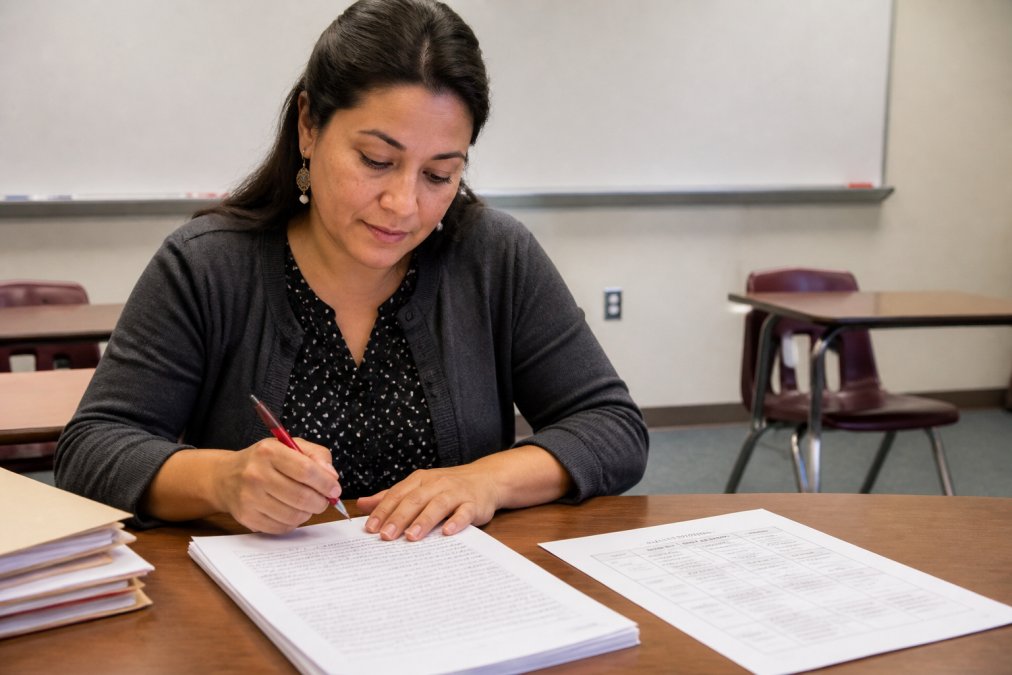
A common mistake is rubric language students can't parse. "Demonstrates sophisticated command of language" means nothing to a ninth grader. "Uses varied sentence structure and precise vocabulary; errors don't interfere with meaning" gives them something to aim at.
Share the rubric before the assignment, not with the grade. A rubric handed back with a score is a verdict. A rubric handed out at the start is a map.
Providing Constructive Feedback on Student Essays
Providing constructive feedback on student essays means prioritizing what will change the next draft. The discipline is in what you leave out: a page covered in corrections teaches students that revision means fixing commas.
Focus comments on two or three patterns per essay. If a student consistently drops their thesis in body paragraphs, mark that. Let the comma splices wait. You can address conventions separately through targeted mini-lessons.
The Feedback Loop: From Comments to Revision
Feedback that doesn't produce revision is wasted effort. Build a required revision step into every major assignment: students respond to your comments in writing, then resubmit the revised section.
This closes the loop and gives you evidence that the feedback landed. It also changes how students read your comments. When they know they'll have to act on them, they read differently.
Digital Writing Assessment Tools for Modern Classrooms
Digital writing assessment tools handle the logistics that eat your planning time: distributing prompts, collecting submissions, attaching rubrics, tracking who has revised. The pedagogical work stays with you.
What matters when evaluating a platform is control over content and a clear review process: define the assessment criteria yourself, see exactly what students submitted, and know whether AI tools were involved and how. A workspace students already understand reduces the training burden mid-year.
Classroom Writer was built for this specific workflow: focused digital writing spaces where teachers create and structure their own assessment content, deliver it through a familiar process, and keep full control over what's being evaluated. It integrates with supported AI platforms including ChatGPT, Claude, and Mistral, so AI use happens inside a structure you define rather than in a separate tab you can't see.
Pricing for platforms in this category varies by institution size and requirements. Check Classroom Writer's site for current plans, and note that a free option is available for teachers who want to test the workflow first.
AI-Assisted Assessment: What Teachers Need to Know
AI-assisted assessment works best as a first-pass tool, not a final judge. It can flag patterns, suggest rubric-aligned comments, and speed up mechanical review. It cannot know your students, your standards, or what a draft is trying to become.
The honest limitation: AI detection is unreliable. False positives fall hardest on multilingual learners and students with unconventional writing styles. Treating a detection score as proof of misconduct creates real harm, and many institutions have abandoned the practice.
What works instead is process evidence. If you can see a student's drafts, revision history, and in-class writing alongside the final piece, you have a far stronger basis for a conversation than any single detection percentage.
Three Practical AI Workflows for Writing Assessment
1. Rubric-aligned comment generation. Paste a student draft and your rubric into a tool like ChatGPT or Claude, then prompt: "Identify two strengths and two areas for revision based on these criteria. Quote specific lines." Review and edit before sharing. This roughly halves comment-writing time, but verify every suggestion, AI often misses context or invents praise.
2. Pattern spotting across a stack. After collecting quick writes, paste anonymized excerpts into an AI tool and ask: "What recurring grammar or organization issues appear across these samples?" This surfaces lesson-planning data fast. Caveat: AI may overgeneralize from small samples, so treat output as a hypothesis, not a finding.
3. Student-facing revision prompts. Give students a structured prompt like: "Here is my draft and my rubric. Ask me three questions that would help me revise, but do not rewrite my sentences." This keeps ownership with the student and builds metacognition. It works best when you model the prompt once in class.
What AI Cannot Do
AI cannot assess voice, originality of thought, or whether an argument suits a specific audience. It cannot know that a student's flat tone reflects exhaustion rather than disengagement, and it cannot replace the professional judgment that comes from knowing your students and standards.
This is where structured platforms earn their place. When AI use happens inside a controlled environment with a defined review process, you're assessing the work and the process together rather than guessing after the fact. Tools that don't force AI on you matter here too: if a teacher wants to run an assessment with no AI involvement at all, that should be a setting, not a workaround.
Differentiated Assessment for Neurodivergent and Multilingual Learners
Differentiated assessment adjusts how students demonstrate proficiency without lowering the standard. For neurodivergent learners, that might mean extended time, oral defense options, or staged checkpoints with feedback between each.
For multilingual learners, the key distinction is between language proficiency and writing proficiency. A student still acquiring English syntax may have fully formed ideas. Scoring conventions and content in separate rubric categories makes that visible instead of burying it in one number.
Specific Rubric Adjustments by Learner Profile
ADHD: Executive function challenges affect planning and sustained attention more than writing ability. Adjust the assessment process, not the criteria:
- Break long essays into three graded checkpoints (outline, draft, final) with feedback between each
- Allow oral brainstorming recorded as audio before drafting
- Use a checklist rubric with concrete, sequential steps rather than holistic descriptors
- Permit short breaks during timed writing or offer untimed alternatives
Dyslexia: Reading and spelling difficulties can mask strong ideas. Separate conventions from content in every rubric, and consider:
- Allowing speech-to-text for drafting (assesses composition, not transcription)
- Providing extra time for reading and responding to prompts
- Scoring organization and ideas without penalizing spelling unless it interferes with meaning
- Offering oral presentation as an alternative to written submission for some assignments
Dysgraphia: Motor challenges make handwriting slow and painful. Digital tools are not a crutch here, they are access:
- Accept typed or dictated drafts as equivalent to handwritten ones
- Allow extended time for any in-class writing
- Use keyboarding accommodations without requiring a formal IEP if the need is evident
- Focus feedback on content and structure, not handwriting legibility
Multilingual Learners (ELL/ESL): The goal is to assess writing development, not just English acquisition. Practical adjustments:
- Use separate rubric categories for language conventions and content/ideas
- Allow planning in the student's first language before drafting in English
- Provide sentence frames for academic writing without requiring them
- Check comprehension of the prompt itself before assessing the response
- Use digital portfolios to show growth across a term rather than snapshot grades
Digital Portfolio Assessment: The Underused Tool
Digital portfolio assessment deserves more attention than it gets. A portfolio shows trajectory, which is what matters for developing writers; a single timed essay shows a moment. For neurodivergent and multilingual learners especially, growth over time is the fairer, more accurate measure.
A simple portfolio structure: students collect three to five pieces across a term, write a short reflection on each explaining what they tried and what they'd change, then present the portfolio in a brief conference. You assess the reflection and the growth, not just the final products. This shifts the question from "How good is this essay?" to "How has this writer developed?", a question that serves every learner better.
How to Assess Student Writing Without Burning Out
Sustainable assessment comes down to triage. Not every piece of writing needs full rubric scoring, and treating every assignment as summative is the fastest route to exhaustion.
Decide the purpose of each assignment before you design it. If it's practice, give feedback on one criterion and skip the grade. If it's summative, score it against the rubric and keep comments brief. If it's diagnostic, read for patterns across the stack and don't mark individual papers at all.
Batch your feedback. Reading thirty essays in one sitting produces worse comments than reading ten at a time, and consistency drops as fatigue sets in. Score one criterion across all papers before moving to the next to keep your standard steady.
Let students carry part of the load. Structured peer review and self-assessment with clear criteria produce usable feedback and build the metacognition that makes your comments land harder when they arrive.
Frequently Asked Questions
What are the most effective ways to assess student writing?
The strongest approach combines formative and summative methods. Use quick writes, exit tickets, and peer review to guide students during the writing process. Then apply rubrics and constructive feedback for summative evaluation. Research supports using multiple writing samples over time rather than a single high-stakes essay. Digital writing assessment tools can automate parts of this workflow, but teacher judgment remains central to meaningful evaluation.
Which is not an effective way to assess student writing?
Grading only for grammar and conventions without addressing content, structure, or ideas is not effective. Red-pen correction without a feedback loop gives students no path to improve. Another ineffective practice is relying on a single writing sample to judge proficiency. Assessment should be evidence-informed and aligned with learning objectives, not just error-counting. Students need clear criteria and opportunities to revise based on feedback.
How can digital writing assessment tools improve the process?
Digital tools reduce time spent on repetitive tasks like tracking revisions and distributing rubrics. They support consistent assessment criteria across multiple classrooms and give students a structured workspace. Platforms like Classroom Writer let teachers create interactive assessments, integrate AI tools like ChatGPT and Claude in controlled environments, and maintain full content control. This supports academic integrity while simplifying the review process for teachers managing large student loads.
How do I provide constructive feedback on student essays without spending hours?
Focus on two or three priority areas per essay rather than marking every error. Use a rubric to anchor comments to specific criteria. Audio or brief written comments tied to revision goals save time and help students act on feedback. Peer review and self-assessment also reduce the teacher's commenting load while building metacognition. Digital tools that store feedback templates speed up the process further.
---
Assessment reform is slow work, and the tools only help if they fit the workflow you already have. Classroom Writer gives teachers focused digital writing and assessment spaces, user-defined content control, and structured delivery that supports academic integrity without forcing AI into every assignment. Get started with Classroom Writer and build an assessment process your students can actually learn from.