
Table of Contents
- Quick Comparison: Digital Writing Platforms for Secondary Students
- How We Evaluated These Platforms
- Classroom Writer: Best for Academic Integrity and Structured Assessment
- Quill.org: Best for Grammar Instruction and Writing Mechanics
- Google Docs: Best Free Option for Collaborative Editing
- Read&Write: Best for Accessibility and Inclusive Learning
- Wattpad and Write the World: Best for Creative Expression and Peer Review
- Grammarly and Hemingway Editor: Best for Revision and Writing Fluency
- Teen Ink and 826 Digital: Best for Publishing and Curriculum Resources
*Last Updated: September 17, 2026*
Quick Comparison: Digital Writing Platforms for Secondary Students
Choosing digital writing platforms for secondary students comes down to matching the tool to the writing problem you're solving. Some platforms excel at grammar drills, others at collaborative drafting or creative publishing, and none of them do everything well. This guide from Classroom Writer breaks down nine platforms by their actual strengths so you can stop guessing and start assigning.
Below, we'll show you exactly how each option performs in a real classroom, where it falls short, and which one fits your department's workflow. The quick table gives you the short version first.
| Platform | Best For | Free Tier | Standout Feature |
|---|---|---|---|
| Classroom Writer | Academic integrity and assessment | Yes | AI integration with teacher oversight |
| Quill.org | Grammar and mechanics | Yes | AI-powered writing feedback |
| Google Docs | Collaborative editing | Yes | Real-time co-editing |
| Read&Write | Accessibility support | Yes (teachers) | Text-to-speech tools |
| Wattpad | Creative expression | Yes | Global publishing audience |
| Write the World | Peer review | Yes | Moderated teen community |
| Grammarly | Revision and fluency | Yes | Real-time grammar checks |
| Hemingway Editor | Concise prose | Yes | Readability scoring |
| Teen Ink / 826 Digital | Publishing and curriculum | Yes | Editorial review and lesson plans |
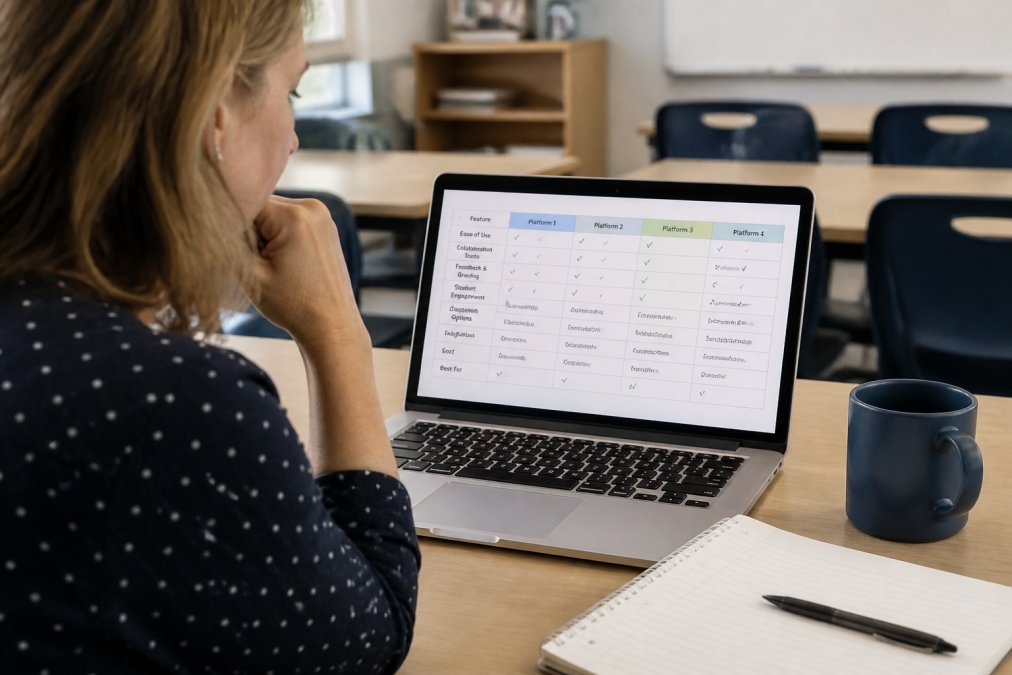
How We Evaluated These Platforms
We scored each platform on five criteria: academic integrity features, ease of integration with existing school workflows, accessibility support, feedback quality, and cost. A platform that ignores data privacy or forces a heavy training load loses points, no matter how many features it lists.
The biggest mistake schools make is adopting a tool because it's popular rather than because it solves a specific writing problem. A grammar drill platform won't fix weak revision habits, and a publishing site won't help you run a timed assessment.
Classroom Writer: Best for Academic Integrity and Structured Assessment
Classroom Writer is the strongest pick for schools that need to maintain academic integrity while letting students use AI responsibly. It provides focused digital writing and assessment spaces where teachers create, structure, and deliver interactive questions, then control exactly how AI tools like ChatGPT, Claude, and Mistral are used inside the platform.
Classroom Writer supports academic integrity by providing focused writing and assessment spaces. Teachers define the assessment content, so students aren't copying and pasting generated answers. The review process stays in the teacher's hands.
Key features:
- Focused digital writing and assessment spaces
- Integration with supported AI platforms under teacher control
- A clear workspace for students that feels familiar
- User-defined assessment content with full teacher oversight
[SCREENSHOT: https://classroomwriter.com]
Quill.org: Best for Grammar Instruction and Writing Mechanics
Quill.org targets grammar instruction and writing mechanics directly, which makes it a natural fit for middle school curriculum and high school writing remediation. Students work through interactive exercises while AI-powered feedback corrects them in real time, and teachers track progress across the class.
The platform aligns with common core standards, so you can slot activities into an existing unit without rebuilding your scope and sequence. It handles sentence combining, punctuation, and vocabulary acquisition well.
Where it falls short: Quill is narrow by design. Assign it for mechanics practice, not for narrative development or long-form essays.
[SCREENSHOT: https://www.quill.org]
Google Docs: Best Free Option for Collaborative Editing
Google Docs remains the default for real-time collaboration because it's free, cloud-based, and already tied to Google Classroom. Students co-edit in the same document, leave comments, and track version history, which makes peer review and drafting process work genuinely easier.
Teachers who want scaffolding can use comment threads as a lightweight teacher feedback loop. The revision cycle becomes visible, not invisible.
The drawback is structural: Google Docs has no built-in rubric-based grading, no grammar instruction, and nothing to stop a student pasting in AI-generated text. You supply the pedagogy; the tool just holds the page.
[SCREENSHOT: https://docs.google.com]
Read&Write: Best for Accessibility and Inclusive Learning
Read&Write is a literacy support toolbar built for inclusive education. Text-to-speech and speech-to-text functions let students with dyslexia or English language learners engage with the same assignments as their peers, while word prediction reduces the friction of getting words onto the page.
Screen masking helps students with attention difficulties focus on one line at a time. Vocabulary and dictionary tools support vocabulary acquisition without leaving the document.
The catch: full functionality usually requires institutional licensing, so budget accordingly. Teachers get free access, but students often need a school-wide subscription.
[SCREENSHOT: https://www.texthelp.com]
Wattpad and Write the World: Best for Creative Expression and Peer Review
Wattpad and Write the World both push students toward creative expression, but they are not interchangeable, and the difference is not just 'one is safer.' The difference is who owns the publishing decision, who moderates the comments, and what data the platform collects from minors. Those three questions determine whether your district will approve the tool at all.
Wattpad is a global publishing platform with hundreds of millions of registered users. Students publish chapters, build a follower base, and receive comments from strangers. For a motivated teen writer, that audience is genuinely motivating, the feedback loop is real and immediate. But Wattpad is a consumer product, not an education product. It is not designed around FERPA or COPPA, it does not offer a school admin tier, and its content moderation is reactive rather than proactive. Age-appropriate content varies widely across genres, and the comment sections are not filtered for a school audience.
If you use Wattpad, treat it as an optional enrichment activity for students 13 and older with written parent permission, not as a class-wide assignment.
A practical comparison for the approval conversation:
| Question | Wattpad | Write the World |
|---|---|---|
| Designed for schools | No | Yes (school program) |
| Age minimum | 13 | 13 |
| Moderation model | Reactive | Proactive |
| Private class groups | Limited | Yes |
| Data privacy posture | Consumer terms | Education-oriented |
The unique angle competitors miss: creative writing platforms are where secondary students are most likely to publish under their real names to a public audience. That makes them the highest-risk category in this entire list from a data privacy standpoint. If your district has not yet built a process for reviewing student publishing tools, this is the category that should trigger one.
[SCREENSHOT: https://writetheworld.com]
Grammarly and Hemingway Editor: Best for Revision and Writing Fluency
- Draft freely in Google Docs or the platform of choice, no grammar tool active.
- Run Grammarly for a correctness pass. Students accept or reject each suggestion and write one sentence in a revision log explaining the most common error type they saw.
- Run Hemingway for a style pass. Students target a specific score (usually two grade levels above their actual grade) and revise the three longest sentences.
- Submit with the revision log attached so the teacher sees the process, not just the product.
LMS and privacy notes. Grammarly integrates with Canvas, Schoology, and Google Classroom through its education offering, and the school tier includes an admin dashboard for managing student accounts. Hemingway Editor does not integrate with any LMS, it is a standalone web or desktop tool, which means students copy text in and out manually. On privacy, Grammarly's school product is designed around FERPA and COPPA requirements, but the free consumer version is not; if students under 13 are using it, the school needs the education tier. Hemingway Editor processes text locally in the desktop app and in-browser in the web version, which makes it the lower-risk option for districts with strict data rules.
[SCREENSHOT: https://hemingwayapp.com]
Teen Ink and 826 Digital: Best for Publishing and Curriculum Resources
Teen Ink and 826 Digital round out the list because they solve two different problems. Teen Ink gives aspiring teen writers a real submission and publishing path, complete with editorial review and print or digital magazine options. It builds a portfolio students can point to.
[SCREENSHOT: https://www.teenink.com]
---
Frequently Asked Questions
What is a good writing platform for students?
A good writing platform for students depends on your goals. For grammar and mechanics, Quill.org offers free interactive exercises. For collaborative editing, Google Docs provides real-time collaboration and version history. For academic integrity and structured assessment, Classroom Writer gives teachers control over content and integrates with AI platforms like ChatGPT and Claude. Look for features like feedback tools, accessibility support, and LMS integration to match your classroom needs.
How do digital writing platforms improve student writing outcomes?
Digital writing platforms improve outcomes by providing immediate feedback, tracking progress, and supporting revision cycles. Tools like Quill.org offer AI-powered grammar feedback, while Grammarly checks tone and clarity. Research shows that frequent, low-stakes writing with timely feedback builds writing fluency. Platforms that support drafting and revision workflows help students internalize the writing process, leading to stronger literacy skills over time.
Can digital writing platforms help with academic integrity?
Yes, platforms like Classroom Writer support academic integrity by providing focused writing spaces and integrating with AI tools in controlled ways. Teachers can review student work, check version history, and use plagiarism detection features. Some platforms allow AI-assisted writing while maintaining oversight, helping schools balance innovation with integrity. Look for features like rubric-based grading and teacher feedback loops to ensure authentic student work.
What features should educators look for in a secondary writing platform?
Prioritize features that align with your teaching goals: grammar and mechanics support, collaborative editing, accessibility tools like text-to-speech, and LMS integration. For assessment, look for rubric-based grading, formative assessment capabilities, and academic integrity features. Pricing models vary; many offer free tiers for teachers. Consider ease of use, data privacy compliance (COPPA/FERPA), and whether the platform supports differentiated instruction for diverse learners.