
Table of Contents
- Why AI Detection Tools Alone Cannot Guarantee Assessment Control
- False Positives and the Limits of Detection Accuracy
- How AI Detection Algorithms Work and Where They Fail
- Building an AI Academic Integrity Scale for Your Classroom
- Low, Medium, and High Concern: Matching Response to Evidence
- Process-Based Assessment Examples That Keep Teachers in Control
- Rubric-Based Verification Workflows
- Strategies to Prevent AI Cheating in Schools Without Relying on Detectors
- AI-Resistant Assignment Design
- Legal and Ethical Risks of False Accusations
- How Classroom Writer Supports Teacher-Led Verification
- Conclusion
*Last Updated: September 20, 2026*
Why AI Detection Tools Alone Cannot Guarantee Assessment Control
AI detection verification is the practice of confirming whether student work is authentic by combining software signals with evidence from the writing process. This guide from Classroom Writer explains how teachers can keep assessment control when detection tools give unclear or wrong answers.
Here's the core problem: no detector can prove authorship. A high AI score is a signal, not proof. A low score is not a clean bill of health either. Teachers who treat detector output as a verdict hand over their professional judgment to software that cannot defend its conclusions.
Many schools learned this the hard way. Reports of students wrongly accused of using generative models have circulated widely, and each case erodes trust in the whole system. The fix is not a better detector. It is a verification process where the teacher stays in charge.
Below, we break down how detection works, where it fails, and how to build a practical framework that protects both academic integrity and student trust.
False Positives and the Limits of Detection Accuracy
False positives happen when a detector flags human writing as AI-generated. They are the single biggest risk in any detection-based workflow.
Why do they happen? Detection tools look for patterns common in machine writing: uniform sentence length, predictable word choices, low variation in rhythm. But nervous students, English language learners, and writers using formal templates can produce the same patterns. The tool cannot tell the difference.
The consequences are serious. A false accusation can damage a student's record, strain parent trust, and put the school in a difficult legal position. That is why detection accuracy should never be the only line of defense. It should be one input among several, and never the deciding one.
How AI Detection Algorithms Work and Where They Fail
AI detection algorithms work by scoring text against patterns learned from large collections of human and machine writing. They output a probability, not a fact.
Think of it like a smoke alarm. It beeps when it senses something, but it cannot tell you whether there is a real fire or burnt toast. Treating a beep as proof of fire would be absurd. Treating an AI score as proof of cheating is the same mistake.
Three failure points show up again and again:
- Adversarial edits: Students who lightly rewrite AI output can drop the score below any threshold. Hybrid editing defeats most detectors.
- Algorithmic bias: Tools tend to flag formal, non-native, or highly structured writing. That punishes some students unfairly.
- Model drift: Generative models change fast. Detectors trained on last year's output often miss this year's.
Building an AI Academic Integrity Scale for Your Classroom
An AI academic integrity scale is a simple rating system that matches your response to the strength of the evidence. It keeps decisions consistent across assignments and across teachers.
The scale has three levels. Low concern means the work looks authentic and process evidence supports it. Medium concern means something is off, but the evidence is not conclusive. High concern means multiple independent signals point to a problem.
A quick way to visualize it:
| Concern Level | Evidence Required | Teacher Response |
|---|---|---|
| Low | Drafts, history, and style all align | Grade normally |
| Medium | One or two weak signals | Ask for a short oral defense |
| High | Multiple strong signals plus process gaps | Formal review with department |
The scale does one important thing. It forces the conversation onto evidence, not suspicion.
Low, Medium, and High Concern: Matching Response to Evidence
Match your response to the level, every time. This protects students from overreaction and protects you from underreaction.
For low concern, no action is needed beyond normal grading. For medium concern, a five-minute conversation or a quick in-class writing sample usually settles it. For high concern, follow your school's formal process and document everything.
The key is consistency. When every teacher uses the same scale, students cannot claim they were singled out. And your department head has a clear record if a case escalates.
Process-Based Assessment Examples That Keep Teachers in Control
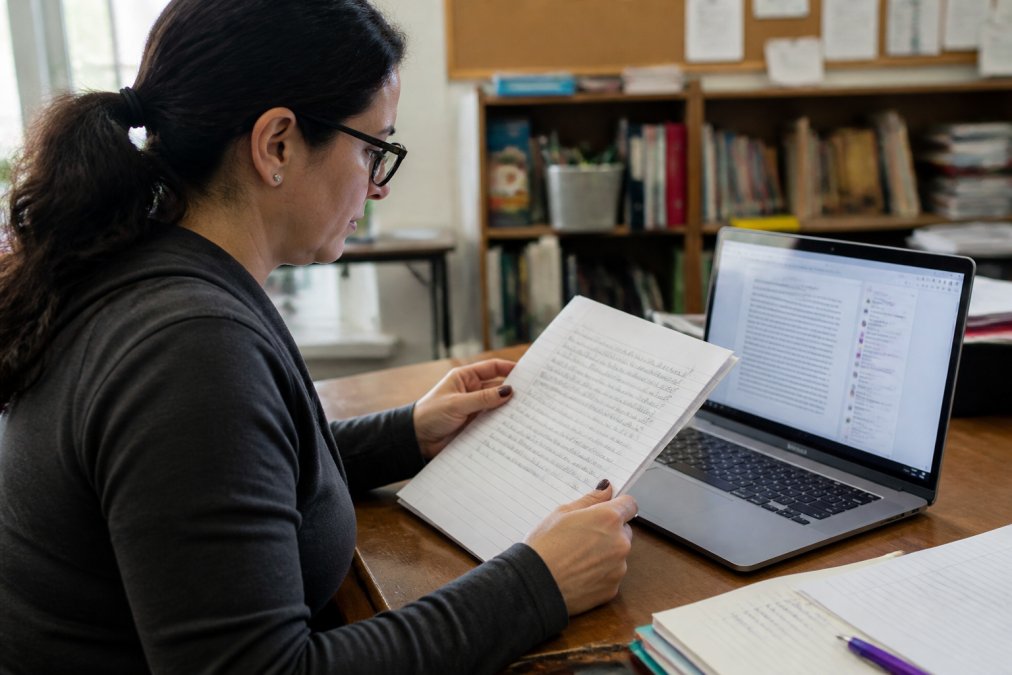
Process-based assessment examples include draft checkpoints, revision logs, oral defenses, and rubric-scored writing samples collected over time. These give you circumstantial evidence of authorship that no detector can provide. The key word is *circumstantial*: you are not trying to prove a negative, you are building a record that makes authorship visible.
Here is what this looks like in practice:
- Draft checkpoints: Collect an outline, a first draft, and a final version. Each stage shows the student's thinking as it develops. A useful rule of thumb is three checkpoints minimum for any assignment worth more than 10% of the grade, fewer than that and the gap between stages is too wide to read.
- Revision logs: Ask students to note what they changed and why. This is hard to fake and easy to review. Two or three sentences per revision is enough; longer logs become busywork and students stop writing them honestly.
- Oral defense: A two-minute question about the student's own argument reveals understanding fast. Ask *why* they chose a specific example or *what* they would change if they had another week, these questions have no generic answer.
- Timed writing: A short in-class response on the same topic gives you a comparison sample. Even ten minutes of handwritten or locked-browser writing produces a stylistic baseline you can compare against later submissions.
- Annotated bibliographies in the student's own voice: A one-sentence summary of each source, written without looking at the source text, exposes whether the student actually read it.
Rubric-Based Verification Workflows
A rubric-based verification workflow scores the process, not just the product. Build a short rubric with three or four criteria: planning evidence, revision quality, source handling, and reflection. Score each one from 1 to 4.
Strategies to Prevent AI Cheating in Schools Without Relying on Detectors
Strategies to prevent AI cheating in schools work best when they change the assignment, not just the policing. The strongest defense is design.
Start here:
- Ask for personal experience or local examples that AI cannot guess.
- Require source annotations in the student's own words.
- Break big tasks into staged checkpoints with feedback between them.
- Use oral components for high-stakes work.
- Teach digital literacy so students understand acceptable use.
AI-Resistant Assignment Design
AI-resistant assignment design means building tasks where the process is visible and the output depends on local context. Compare a generic essay prompt to a task that asks students to interview a family member and connect the findings to a course concept. The second is far harder to outsource.
Legal and Ethical Risks of False Accusations
The legal and ethical risks of false accusations are real and growing. A wrong accusation can breach a school's duty of care, damage a student's record, and trigger formal complaints from parents.
How Classroom Writer Supports Teacher-Led Verification
Classroom Writer is built for exactly this problem. It gives teachers focused digital writing and assessment spaces where the process stays visible from start to finish.
- Focused writing spaces keep students in a clear, structured workspace.
- Integration with supported AI platforms like ChatGPT, Claude, and Mistral, so AI use is structured and visible rather than hidden.
- User-defined assessment content means you decide the questions, prompts, and rubrics.
- A familiar workflow for schools keeps the learning curve low for staff.
Conclusion
The hard truth is that no detector can carry the weight schools keep putting on it. Verification has to live with the teacher, in the process, in the design of the work itself.
Frequently Asked Questions
Why is AI detection often unreliable for student assessments?
AI detectors analyze writing style patterns using machine learning, but they produce false positives, especially with neurodivergent students or non-native English speakers. Detection accuracy varies widely across tools and text types. A detector flagging a submission is circumstantial evidence, not proof. Teachers who rely solely on detection scores risk accusing students incorrectly. Using detection as one data point alongside process evidence, drafts, and rubric-based review keeps assessment control where it belongs.
How can teachers design assessments that are resistant to AI generation?
AI-resistant assignment design focuses on tasks that require personal context, in-class drafting, or iterative revision. Examples include reflective journals tied to classroom discussions, oral defenses of written work, and assignments that build across multiple drafts. These approaches make generative models less useful because the work depends on specific, lived experience. Pairing design changes with process-based assessment examples like annotated bibliographies and peer review logs gives teachers verifiable evidence of authorship.
What are the best practices for verifying student work without relying solely on AI detectors?
Combine multiple evidence sources: draft history, in-class writing samples, rubric-based evaluation, and short verbal check-ins about the work. Keep a record of each student's writing process over time so style shifts stand out. Use an AI academic integrity scale to match your response to the strength of evidence rather than treating every flag as confirmed misconduct. This human-in-the-loop approach supports student accountability and reduces the legal and ethical risks of false accusations.
How does Classroom Writer help teachers maintain control over assessment content?
Classroom Writer provides focused digital writing and assessment spaces where teachers define the content, structure, and rubric. It integrates with supported AI platforms like ChatGPT, Claude, and Mistral inside a controlled environment, so you can see how students use AI rather than guessing. The platform supports academic integrity through structured workflows, simplifies creating interactive questions, and keeps teachers in charge of what gets assessed. A free plan is available to start.